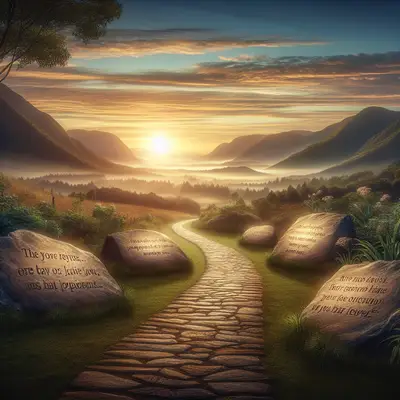
There’s a quiet moment that happens in every life: you look around at your ordinary day and realize this is it—this is the life you’re actually living, not the one you’re still planning. In that pause, the right words can feel like a hand on your shoulder, turning your face gently toward what matters. These life quotes are not about chasing perfection; they are about paying attention, choosing courage in small ways, and remembering that meaning often shows up in the middle of the mess.
Below you’ll find five powerful quotes, each followed by a reflection to help you carry them into your real, unedited life—the one happening between alarms, emails, and late-night quiet.
1. “How we spend our days is, of course, how we spend our lives.” – Annie Dillard
Most people imagine their “real life” starting later—after the promotion, after the move, after things calm down. This quote pulls that illusion apart with a single sentence. Your life isn’t waiting in the distance; it’s being built from the way you show up today: how you listen, what you notice, whether you choose kindness when no one is keeping score.
When you feel stuck, it can help to zoom in on the day instead of the decade. Ask yourself: If my whole life looked like today, would I be proud of how I treated myself and others? You don’t need a perfect answer; you just need an honest one. From there, change stops being a grand reinvention and becomes a small rearranging of priorities—five minutes of reading instead of scrolling, one genuine conversation instead of three half-hearted ones, a short walk instead of yet another excuse.
This quote is not a demand for constant productivity; it’s an invitation to conscious living. If “how you spend your days” includes rest, presence, and real connection, then your life will, too.
2. “In the middle of difficulty lies opportunity.” – Attributed to Albert Einstein
Hard seasons often arrive without warning—an illness, a broken relationship, a lost job, a version of yourself you no longer recognize. In those moments, this quote can feel too simple, almost unfair. But it isn’t saying difficulty is good; it’s saying difficulty is dense—packed with the possibility for rethinking, reshaping, and rediscovering what matters.
Opportunity doesn’t always look like success. Sometimes it looks like learning to ask for help, setting boundaries for the first time, or realizing that your worth was never tied to the role you just lost. It might be the chance to become gentler with yourself, or to see others’ pain with new understanding because now you’ve walked through your own.
When life is heavy, you don’t have to force gratitude for what hurts. Instead, you can ask quieter questions: What is this teaching me about my strength? About my limits? About what I can no longer ignore? The opportunity is not to suffer more bravely, but to live more honestly on the other side.
3. “Tell me, what is it you plan to do with your one wild and precious life?” – Mary Oliver
This line feels like someone pulling back a curtain and letting the full brightness of your existence pour in. It doesn’t ask what you plan to achieve, collect, or prove. It asks what you’re willing to do with a life that is both wild—unpredictable, fragile, surprising—and precious—irreplaceable, finite, singularly yours.
You don’t need a perfect plan or a dramatic calling to answer this question. You simply need to admit what moves you. Maybe your “wild and precious” looks like raising kind children, building something useful, fighting for justice in your community, staying curious, or choosing love over safety again and again. Maybe it looks like allowing yourself joy even when the world is imperfect.
This quote is a gentle interruption to autopilot living. When you hear it, notice where your mind goes first. What do you wish you were doing more of? What do you regret postponing? Those first, unfiltered answers are worth taking seriously. You may not act on them all at once, but you can begin by giving them a place in your week, not just your imagination.
4. “The only person you are destined to become is the person you decide to be.” – Ralph Waldo Emerson
It’s easy to believe that your life is mostly shaped by forces outside your control—where you were born, who you know, what you’ve been through. Those things matter. They draw the outlines of your story. But this quote points to a deeper truth: inside those outlines, you still get to choose your colors.
You decide, over and over, how you respond to disappointment, how you treat people who can’t offer you anything back, how honest you’re willing to be about your own flaws. You decide whether to repeat the patterns you were handed or to gently interrupt them. You decide whether to live small to avoid risk or to step forward knowing there are no guarantees.
This doesn’t mean you can become anyone by pure willpower; reality and limits are real. But it does mean your character is not fixed. Courage is a decision that begins while your hands are still shaking. Integrity is a decision you make when shortcuts are tempting. Healing is a decision you revisit on the days you’d rather numb out than feel. Each decision is a brushstroke in the portrait of who you’re becoming.
5. “It is never too late to be what you might have been.” – Commonly attributed to George Eliot
Regret has a way of whispering that you’ve missed your chance—that you’re too old, too behind, too broken, too far gone to change course. This quote sits beside that voice and offers a different story: time has passed, yes, but you are still here, and that means possibility is still here, too.
Being “what you might have been” doesn’t always mean chasing the exact dream you had at 18. Sometimes it means honoring the essence of what you longed for—creativity, freedom, service, learning—and finding ways to live that out in the life you have now. Maybe you won’t become a professional musician, but you can still make music. Maybe you won’t start over in a new city, but you can start over in how you show up where you are.
Change doesn’t erase the years behind you; it reframes them. Everything you’ve lived through can become part of the depth you bring to your new choices. You can begin again with more wisdom, more humility, and more clarity about what truly matters to you. As long as there is breath in your lungs, you are not finished.
Conclusion
Life rarely announces its turning points. Most of the time, change begins quietly—with a sentence that won’t leave you alone, a question that keeps echoing, a quote that feels like it was written with your name tucked inside it. The words you’ve just read are not magic spells; they are invitations.
You are invited to treat your days as pieces of a whole, not just obstacles to “real life.” You are invited to look for meaning inside difficulty, to honor what makes your one life feel wild and precious, to decide who you’ll be instead of waiting to find out, and to let go of the idea that it’s too late to begin.
You don’t have to change everything today. But you can choose one small way to live more awake, more honest, and more true to yourself before this day is over. That’s how lives are built—one decided moment at a time.
Sources
- [Annie Dillard – Profile and Works (Hollins University)](https://www.hollins.edu/academics/distinguished-visiting-faculty/annie-dillard/) – Background on Annie Dillard, the author of the “how we spend our days” quote
- [Einstein Archives Online – Albert Einstein Collection (Hebrew University of Jerusalem)](https://einsteinpapers.press.princeton.edu/) – Primary documents and context for quotes commonly attributed to Albert Einstein
- [Mary Oliver at The Poetry Foundation](https://www.poetryfoundation.org/poets/mary-oliver) – Biography and selected poems, including the poem containing the “one wild and precious life” line
- [Ralph Waldo Emerson – Essays and Biography (Stanford Encyclopedia of Philosophy)](https://plato.stanford.edu/entries/emerson/) – Scholarly overview of Emerson’s life, philosophy, and writings
- [George Eliot (Mary Ann Evans) – Biography (Encyclopedia Britannica)](https://www.britannica.com/biography/George-Eliot) – Background on George Eliot, often associated with the “never too late” quote
Key Takeaway
The most important thing to remember from this article is that this information can change how you think about Life Quotes.